
There is an unmistakable shift that happens across India Raksha Bandhan August rolls around. The monsoon has already done its heavy lifting, painting the countryside in rich, velvety greens. The air itself feels thick with the scent of damp earth, crushed jasmine, and morning filter coffee. If you wander down any local market street, the usual rows of everyday shops are suddenly pushed aside by vibrant, chaotic stalls draped in thousands of glittering threads, silken tassels, and tiny glass beads.
This is the chaotic, beautiful prelude to Raksha Bandhan.
To anyone looking from the outside, the ritual might seem almost too simple to carry much weight. A sister ties a woven string around her brother’s wrist, drops a piece of sweet into his mouth, and walks away with a gift or an envelope of cash. But if you grew up with this tradition, you know that the string is just the visible tip of an enormous emotional iceberg.
Raksha Bandhan is an annual pause button on the relentless grind of modern life. It forces us to slow down, look across the room, and truly see the person who shared our childhood bedroom, blamed us for the broken vase, fought us for the last slice of mango, and yet remains the absolute anchor of our sanity.
In an age where everything feels temporary, disposable, and filtered through a screen, this festival stands out as something fiercely permanent. It is a living reminder of an old Indian truth: our relationships are not just social contracts or convenient arrangements. They are sacred, lifelong ties that deserve to be protected with everything we have.
Raksha Bandhan The Weight and Warmth of a Promise

To really understand the emotional gravity here, you have to break down the words themselves. Raksha means protection or shelter. Bandhan means a tie or an obligation. Put them together, and you get something far richer than a simple promise of physical defense.
When a sister ties a rakhi, she isn’t looking for a bodyguard; she is wrapping her brother in a quiet shield of love, wishing him the kind of internal strength and peace that gets a person through life’s darkest seasons. In return, the brother’s promise isn’t about picking a fight with her enemies; it is a vow of absolute emotional availability. It is his way of saying, No matter how messy life gets, or how far apart we drift, you will never have to face the world alone.
In a traditional Indian home, family isn’t a secondary part of your life—it is the sun everything else orbits around. The relationship between siblings is entirely unique because it is our very first taste of unconditional companionship. Your siblings are the only people on the planet who truly understand the specific madness of your household, the exact temperament of your parents, and the unspoken rules you all grew up living by.
The real magic of this festival is that it acts as a grand emotional reset button. Whatever petty arguments, unspoken resentments, or long silences have built up over the year seem to melt away the second that thread is tied. It is a beautiful, necessary reminder that while jobs change, friendships shift, and people move away, the blood ties of your youth remain a permanent safe harbor.
Echoes from the Evenings of Old

The foundations of Raksha Bandhan are buried deep in stories that grandmothers have whispered to children for centuries. These legends aren’t just fairy tales; they form the moral compass that explains why a fragile piece of thread can carry more weight than an army’s decree.
Take the famous story from the Mahabharata. During a massive royal gathering, Lord Krishna accidentally cut his wrist on a weapon. While the kings and courtiers panicked, looking for royal physicians or silk bandages, Draupadi didn’t waste a heartbeat. She immediately stepped forward, tore a strip of fabric right from the edge of her beautiful saree, and wrapped it tightly around his bleeding wrist to stop the flow.
Deeply moved by her instinct to help, Krishna promised to return the favor whenever she found herself in desperate need. Years later, when Draupadi faced ultimate humiliation in a court full of silent men, Krishna kept his word, extending her clothes infinitely to protect her dignity. That single torn strip of a saree became the spiritual blueprint for the rakhi—a symbol showing that a gift given out of pure love creates an unbreakable bond of honor.
History, too, is full of these moments where a thread changed the course of lives. One legendary account tells of Rani Karnavati, the widowed queen of Chittor, who realized her kingdom was about to be overrun by an overwhelming invading army. Desperate to save her people, she sent a sacred rakhi to the Mughal Emperor Humayun, calling on him as a brother.
Even though they came from different worlds, cultures, and religions, Humayun recognized the immense honor of the gesture. He paused his own military campaigns and immediately marched his troops to her aid. These stories prove that the spirit of the rakhi has never been exclusive or narrow; it has always been a universal language of chivalry, respect, and deep humanity.
Raksha Bandhan The Joyful Chaos of the Morning Ritual

On the morning of the festival, an Indian home wakes up to a specific kind of beautiful, noisy energy. The kitchen gets busy first, filling every corner of the house with the warm, heavy scents of roasting ghee, crushed cardamoms, and sweet, boiling milk. The diet plans are completely thrown out the window; today is all about handmade laddoos, rich kaju katli, and bowls of creamy kheer that feel like a warm hug.
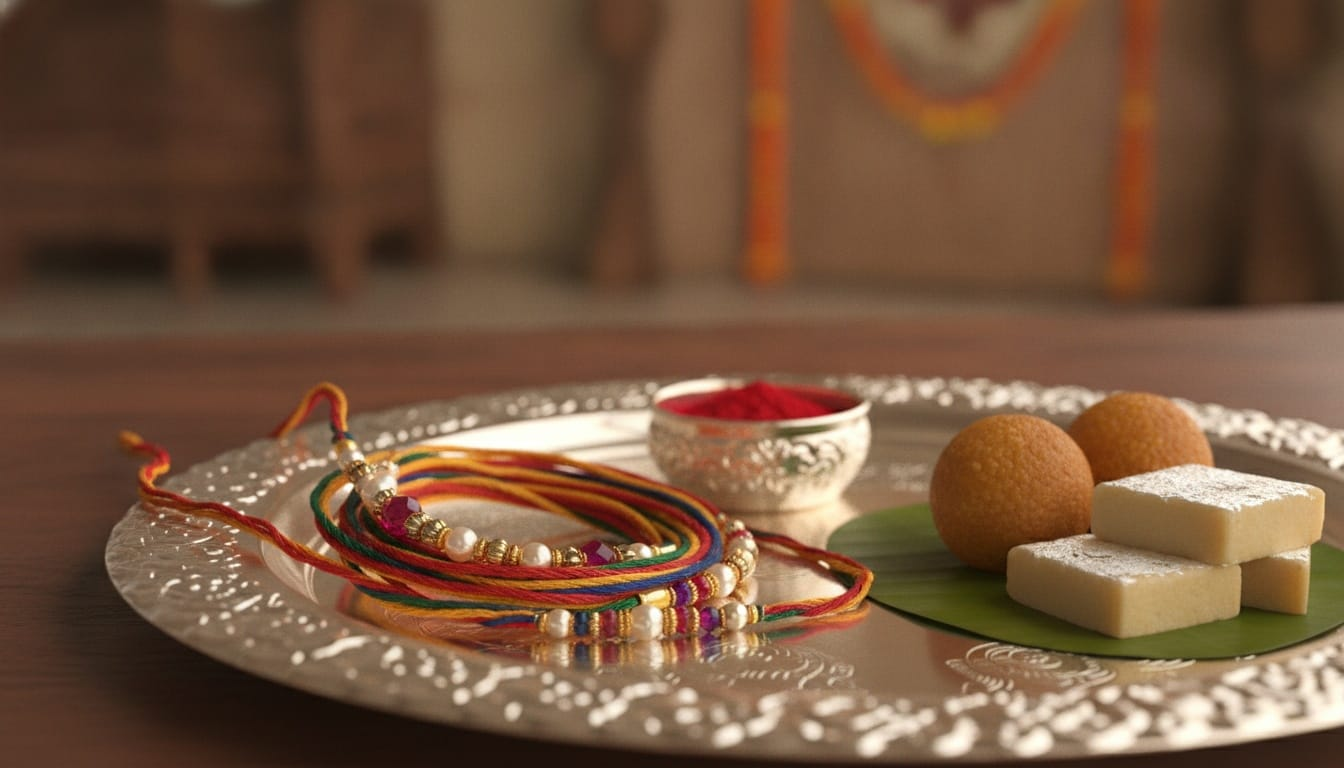
The ceremony itself is a slow, beautiful, deeply sensory experience. The sister spends days picking out the perfect rakhi, and on the morning of the festival, she sets up a brass thali (ceremonial plate) like a miniature work of art. On it sits a small, flickering clay lamp, a bowl of bright red vermilion paste (roli), raw rice grains, and a mountain of sweets.
When the brother finally sits down, the world shrinks to just the two of them, and the ritual moves through moments that are both solemn and sweet:
- The Tilak: She presses a thumb of red paste onto his forehead, anchoring it with a few grains of rice—a blessing for clarity, wisdom, and long life.
- The Aarti: She gently circles the warm clay lamp in front of his face to clear away any negative energy or hidden hardships.
- The Tying: With steady hands, she knots the colorful silk thread around his right wrist, often closing her eyes to send a silent prayer up into the universe.
- The Sweetness: They feed each other a bite of dessert, and the quiet solemnity instantly breaks into wide smiles, teasing, and laughter.
Then comes the fun part—the gifts. While it used to be a simple envelope of pocket money, modern celebrations are wonderfully personal. You see brothers giving everything from a book they know their sister will love, to handwritten notes, or a tech gadget she’s been saving up for. Afterwards, the house dissolves into a massive, boisterous family lunch where aunts, uncles, and cousins swap old childhood stories and keep the shared history alive.
Raksha Bandhan The Bitter, Sweet Reality of Growing Up Together


To speak honestly about Raksha Bandhan, we have to move past the perfect, polished photos we see online and talk about what siblinghood actually feels like. Real sibling relationships are forged in the trenches of daily life. They are built on a foundation of borrowed clothes without permission, loud arguments over who gets the front seat of the car, and a lifetime of knowing exactly which buttons to push to make the other person lose their mind.
But underneath all that noise is an absolute, terrifying loyalty. Your sibling is the one person who will relentlessly tease you about an embarrassing phase or a bad decision at home, but will instantly turn into a fierce protector if anyone outside the family dare to bring you down. They are the ones who have seen you at your absolute lowest points—broken-hearted, exhausted, or failing—and their opinion of you never wavered.
“A sibling is someone who holds the blueprint of your childhood. They know where you came from, they remember the names of your childhood pets, and they understand your scars. Raksha Bandhan is the one day we look past the daily friction and say what we usually take for granted: Thank you for being my constant companion in this wild life.“
This festival gives that beautiful, complicated relationship the stage it deserves. It allows grown men, who spend their week being tough and stoic in the corporate world, to sit quietly on a couch, let their sister tie a bright pink string to their wrist, and genuinely feel the warmth of gratitude. It gives sisters a reason to drop their demanding schedules and look after the boy who used to be a complete regular nuisance, realizing he’s grown into one of her greatest allies.
How Love Bridges the Digital Divide

As the world has grown bigger and families have scattered across the globe, the logistics of the festival have changed completely. It’s incredibly common now for a sister to be working late nights in a hospital in Chicago while her brother is navigating a tech career in the crowded lanes of Hyderabad.
Yet, instead of letting the tradition fade into a chore, modern siblings have used technology to keep the heartbeat of the festival alive. Weeks before the full moon, online spaces fill up with artisan shops selling custom, eco-friendly rakhis. You can find threads made of organic cotton, natural clay, or embedded with plantable seeds that will grow into flowers long after the festival is over. These are shipped across oceans alongside boxes of local sweets with a few taps on a screen.
On the day itself, screens become the sacred space. Video calls connect kitchens and living rooms across vast time zones. A sister will hold the thread up to her camera lens, read her prayers aloud, and watch as her brother ties a thread around his own wrist, or asks a sister-in-law to do it for her. The distance vanishes because the raw emotion moving through the airwaves is undeniably real.
Even better, the definition of who gets a rakhi has beautifully widened. Today, sisters without brothers tie rakhis to each other, celebrating a lifetime of sisterly protection. People tie them to their closest friends, to single mothers who carried the family alone, and to the community workers who keep neighborhoods safe. The tradition has broken out of its old boxes, proving that the desire to connect and protect is a universal human need.
More Than Just String and Beads


If you look closely at a collection of rakhis, you aren’t just looking at festive decorations; you are looking at a history of changing artistic tastes. Long ago, a rakhi was nothing more than a mouli—a simple, raw cotton thread dyed in sacred strokes of crimson and yellow. It didn’t need plastic beads or shiny crystals because the true power was believed to live entirely within the prayers whispered while tying the knots.
Over the generations, the thread became a brilliant canvas for local craft. For little kids, rakhis are pure fun—featuring bright cartoon characters, tiny flashing lights, or small toys. For adults, they can be beautiful pieces of wearable art made from sandalwood beads, sacred seeds, freshwater pearls, or even delicate filigree silver that can be worn like a bracelet for the rest of the year. Many people now deliberately seek out handmade rakhis crafted by women’s shelters or rural artisan collectives, turning their holiday shopping into a quiet act of kindness for the community.
But whether the thread on a man’s wrist is a piece of fine silver or a simple red string that cost a few rupees, the value inside it stays exactly the same. Long after the festival ends, you will see men continuing to wear their rakhis through regular workdays, gym sessions, and commutes until the cotton naturally frays and falls away. Every time they look down at their wrist while stuck in traffic or working at a computer, that little piece of faded string serves as a quiet, powerful anchor reminding them of where they come from and who loves them unconditionally.
A Nation Celebrating in Different Voices

While the deep emotional core of the festival stays the same everywhere, India’s massive cultural variety means that this single August full moon day looks remarkably different depending on where your feet are planted.
Down along the breezy coastlines of Maharashtra and Goa, the day is celebrated as Narali Purnima. For families who depend on the ocean for survival, this day marks the official welcome of calmer waters after the rough monsoon storms. People dress up, walk down to the shore in singing processions, and offer golden coconuts to the god of the sea, praying for safe travels and full nets. Here, the idea of protection widens to include a deep, beautiful respect for the power of nature.
In the farming communities of Central India, the day is known as Kajari Purnima. It’s a time for women and farmers to pray for a rich, healthy harvest, using small handmade leaf cups filled with soil to nurture young barley sprouts. Meanwhile, in Southern India, the day often aligns with Avani Avittam, a sacred time where men change their spiritual threads and recommit themselves to lives of honesty, learning, and honoring their ancestors. Seeing all these different traditions happen under the exact same full moon shows how a simple idea of protection can expand to cover an entire country with blessings and community spirit.
The Quiet Power of an Old Tradition

It is incredibly easy in our fast, cynical world to look at ancient holidays and write them off as sentimental habits from the past. But Raksha Bandhan survives, and thrives, because it treats a very modern ache: the quiet isolation of our hyper-connected, digital lives. We spend our days collecting likes, sending quick texts, and catching up through status updates, yet we rarely tell the people who matter most how much we need them.
This festival doesn’t let you hide behind a text message. It demands your presence, your focused attention, and your voice. It forces you to sit down with your sibling, look them in the eyes, and do something old, vulnerable, and completely sincere. It is a moment of deep emotional grounding wrapped up in a family celebration.
For parents, watching their adult children come together for this ritual brings a profound sense of peace. It is the comfort of knowing that long after they are gone, their children will still be held together by a network of love, ready to show up for each other when life gets difficult. It reminds everyone in the room that true wealth isn’t found in our bank balances or achievements, but in the strength of the emotional safety nets we build around the people we love.
A Living Legacy for the Little Ones

When you strip away the markets, the gifts, and the sweets, the true beauty of Raksha Bandhan is its ability to live forever. Every year, when a parent holds the small, clumsy hand of a toddler to help them tie their very first rakhi, a quiet spark of cultural memory passes to the next generation. Children watch the hugs, the small tears of gratitude, and the laughter of the adults, and they absorb what it truly means to belong to a family.
It is a living, breathing tradition that refuses to grow cold. It teaches us that love isn’t just an abstract feeling you experience; it is an active choice you make every single day through your actions, your time, and your patience.
As the night ends, the dishes are cleaned, and everyone returns to the rush of their normal lives, those bright threads tied around millions of wrists remain as small flags of hope. They stand as a quiet promise that no matter how loud, unpredictable, or difficult the world outside becomes, the bond between siblings will always hold fast, anchored in a love that time can never wash away.
FAQs
1. What is the meaning of Raksha Bandhan?
Raksha Bandhan means the bond of protection. It is a festival that celebrates the loving relationship between brothers and sisters, where a sister ties a rakhi on her brother’s wrist and prays for his well-being while the brother promises care and support.
2. Why is Raksha Bandhan important in Indian culture?
Raksha Bandhan is important because it reflects values such as love, duty, trust, respect, and family unity. It is one of the most meaningful Indian festivals because it turns a sibling relationship into a sacred celebration.
3. How is Raksha Bandhan celebrated in India?
It is celebrated by tying a rakhi, performing a small prayer or aarti, exchanging sweets and gifts, and spending time with family. Many homes also prepare special meals and festive desserts to make the day more memorable.
4. Can Raksha Bandhan be celebrated between cousins or close friends?
Yes, many people now celebrate Raksha Bandhan with cousins, close friends, and people they consider as protective and supportive in their lives. The festival has become more inclusive while keeping its traditional meaning.
5. What is the significance of the rakhi thread?
The rakhi thread is a symbol of love, protection, and connection. It represents a sister’s prayer for her brother’s safety and a brother’s promise to protect and support her.



Leave a Reply