
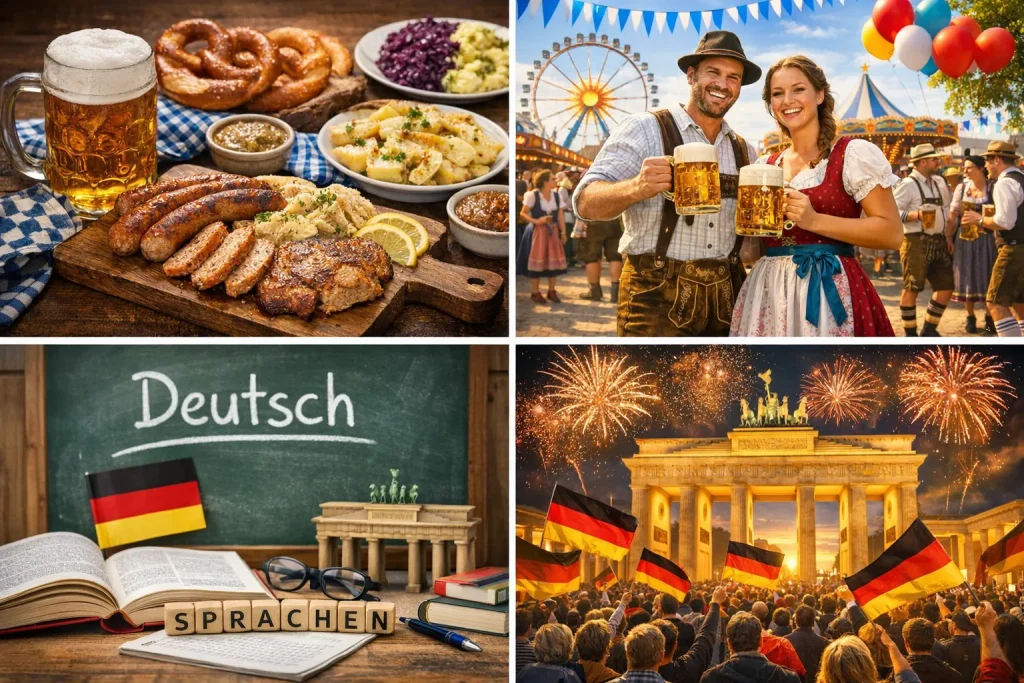
There is a widespread, almost cartoonish stereotype that exists in the global imagination when people think about Germany Culture. It usually involves a man in leather shorts chugging a gigantic mug of beer, a sleek luxury car flying down a highway at terrifying speeds, and a strict, clockwork society where smiling is strictly prohibited unless authorized by a bureaucrat. While it’s true you will find delicious beer, fast cars, and remarkably punctual trains, reducing Germany to these tropes misses the profound, beautiful complexity of the nation.
Underneath that famously orderly surface lies a society shaped by thousands of years of dramatic history, intellectual revolutions, and intense regional pride. Germany is a country that managed to pioneer the printing press, birth some of history’s most radical philosophers and emotional classical composers, rebuild itself from complete physical and moral ruin after World War II, and emerge as the undisputed economic and environmental conscience of modern Europe.
To understand Germany is to understand the constant, delicate balancing act between Ordnung (order) and Gemütlichkeit (a deep, unhurried sense of warmth and cozy contentment). It is a country that works with terrifying efficiency during the week, only to completely shut down on Sundays so everyone can walk quietly through the forest and eat homemade cake with their family.
The Footprints of Giants: How Deep History Shaped Modern German Culture

You cannot understand a modern German’s obsession with rules, stability, and careful planning without understanding their history. Unlike countries that have had unified, centralized identities for a thousand years, Germany as we know it today is actually remarkably young. For centuries, it was a fractured patchwork of hundreds of independent duchies, kingdoms, and free cities operating under the loose umbrella of the Holy Roman Empire.
Because of this fragmented past, German culture developed a unique dual nature:
- A Shared Intellectual Bedrock: A fierce, national pride in the high mind—the country of Dichter und Denker (poets and thinkers) like Goethe, Kant, Bach, and Beethoven.
- An Unshakable Need for Systemic Stability: A collective trauma from past conflicts and economic hyperinflation that converted predictability, legal precision, and social order into spiritual virtues.
When a German citizen insists on waiting for the pedestrian light to turn green at 2:00 AM on a completely deserted street, they aren’t just blindly following a rule. They are upholding a quiet social contract that says rules protect everyone from chaos, and chaos is the ultimate enemy of human flourishment.
Sixteen Countries in One: The Unyielding Power of Regional German Culture

If you tell a local in Munich that they share the exact same culture as someone living in Hamburg, prepare yourself for a polite but firm lecture. Germany’s federal structure isn’t just an administrative convenience; it is a living reflection of ancient tribal and cultural boundaries.
“There is no such thing as a ‘typical German.’ There are Bavarians, Swabians, Saxons, Rhinelanders, and Berliners—who all happen to share a passport and a love for good bread.
The contrast across the country is staggering. In the south, Bavaria feels like a storybook kingdom of snow-capped Alps, dirndls, and brass-band folk music. Head west to the Rhineland, and you’ll find a relaxed, warm-hearted population that throws wildly chaotic street carnivals every February. Head north to the windswept ports of Hamburg or Bremen, and the local culture becomes quiet, understated, and intensely focused on maritime trade and stoic self-reliance.
| German Region | Cultural Vibe | Local Specialty | The Unspoken Rule |
|---|---|---|---|
| Bavaria (South) | Traditional, proud, outdoor-loving | Weisswurst & Pretzels | Never insult their local beer brewery. |
| Berlin (East) | Gritty, artistic, hyper-rebellious | Currywurst | Pretend nothing you see on the street surprises you. |
| Rhineland (West) | Jovial, social, fast-talking | Sauerbraten & Riesling | Join in on the Carnival songs or clear out. |
| Hamburg (North) | Stoic, dignified, maritime-focused | Fresh Fish Sandwiches | Keep your voice down and your handshake firm. |
The Quiet Social Contract: Punctuality, Directness, and Daily Life German Culture
To outsiders, daily interactions with Germans can sometimes feel a bit cold or uncomfortably direct. But if you judge German social interaction through the lens of superficial politeness, you will miss the deep respect that drives it.
In German culture, directness is the highest form of honesty. If a German tells you your plan has a flaw, they aren’t trying to insult you or hurt your feelings. They are trying to fix the problem. They view beating around the bush or offering empty, insincere compliments as a waste of your time and an act of disrespect.
The Pillars of German Daily Etiquette:
- Punctuality is Sacred: Arriving five minutes early is considered “on time.” Arriving five minutes late without texting beforehand communicates that you think your time is more valuable than theirs.
- Feierabend (The Sacred Off-Clock): When the workday finishes, work stops completely. Germans work with terrifying intensity during office hours so they can aggressively protect their personal time to relax with family.
- Ruhezeit (Quiet Hours): Sundays and late evenings are legally protected quiet times. You do not mow your lawn, drill holes in your wall, or vacuum your apartment. The entire society agrees to pause and breathe together.
Bread as a Religion: The Hearty Reality of Culinary German Culture

Mention German food to an outsider, and they will likely picture a giant plate of meat and a side of sauerkraut. While traditional German food is undeniably hearty, the real hero of the German kitchen isn’t sausage—it is bread (Brot).
Bread in Germany is not a vehicle for sandwich meat; it is a sacred cultural institution. Germany produces over 3,000 distinct varieties of bread, ranging from dark, dense, seed-crusted pumpernickels to crusty sourdough rolls known locally as Brötchen. The country’s bakeries are morning community hubs where people buy fresh bread baked that very dawn.
Alongside the bread culture sits the ritual of Kaffee und Kuchen (Coffee and Cake). Around 3:00 or 4:00 PM on weekends, families gather to drink strong filter coffee and eat large slices of homemade cake—like the famous Black Forest Cherry Cake (Schwarzwälder Kirschtorte) or warm plum cake (Pflaumenkuchen). It is a slow, delightful ritual designed to force people to sit down, slow their thoughts, and enjoy conversation.
Winter Magic and Beer Gardens: The Seasonal Joy of Festival German Culture
Germans love gathering in big groups outdoors, but the nature of the gathering changes completely depending on the angle of the sun.
In the warm summer months, life revolves around the Biergarten (Beer Garden). Under the shade of sprawling chestnut trees, people sit together at long wooden benches. A crucial unwritten rule of beer garden culture is that you can sit down at a bench already occupied by strangers—you simply ask “Ist hier noch frei?” (Is this seat free?), nod politely, and enjoy your drink alongside them without any pressure to make small talk.
When winter rolls in and the days grow short and chilly, the country transforms into a magical wonderland through its famous Weihnachtsmärkte (Christmas Markets). Town squares across the country are filled with wooden huts selling hand-carved ornaments, gingerbread (Lebkuchen), and steaming mugs of Glühwein (spiced hot mulled wine). Standing in the crisp winter air surrounded by twinkling lights and the smell of roasted almonds is the ultimate expression of Gemütlichkeit.
Waldeinsamkeit: The Spiritual Connection to Nature and Green German Culture

You cannot truly understand the German soul without understanding its deep, almost mystical relationship with the forest (Der Wald). German literature, folklore, and fairy tales (like those recorded by the Brothers Grimm) are rooted deeply in the woods.
The Germans even have an untranslatable word for the specific feeling of being alone in the woods and feeling connected to the universe: Waldeinsamkeit.
This deep emotional connection to the land directly explains why modern Germany is an absolute powerhouse of environmental activism. Recycling is not an afterthought in a German home; it is an art form that involves four or five different sorting bins.
From pioneered solar energy initiatives to strict plastic waste laws, protecting the natural environment is viewed as a fundamental moral duty to protect the country’s beloved forests and rivers for future generations.
The Cathedral of Engineering: Precision, Craftsmanship, and Work German Culture
There is a distinct word in German—Handwerk—that translates to craftsmanship, but carries a far deeper cultural respect than the English word implies. Whether building a complex industrial robot, drafting a set of architectural plans, or baking a loaf of bread, doing a job with meticulous, flawless precision is considered a point of personal honor.
This obsession with quality over speed is why “Made in Germany” became a global stamp of world-class excellence. The culture places massive social value on vocational training through its famous Duales Studium (Dual Education System), where young people spend years mastering a physical trade through a combination of classroom theory and real-world apprenticeship.
In the German workplace:
- Titles Matter: Addressing a colleague as Herr or Frau followed by their last name is standard until you are explicitly invited to use first names.
- Facts Win Arguments: Emotional appeals or flashy sales pitches rarely work in German meetings. Decisions are made using cold, hard data, thorough risk analysis, and structural logic.
- Structure Equals Freedom: Detailed processes aren’t seen as restrictive red tape; they are seen as the blueprint that guarantees nothing goes wrong.
The Unbroken Spirit: Modern Evolution and Pluralistic German Culture

Today’s Germany is a dynamic, complex, and increasingly diverse society. Over the last several decades, waves of immigration—from Turkish guest workers in the 1960s to recent arrivals from across the globe—have reshaped the nation’s urban landscapes, food scenes, and cultural conversations.
Modern cities like Berlin, Frankfurt, and Munich are vibrant, multicultural hubs where traditional bakeries sit alongside Turkish kebab shops, Vietnamese noodle houses, and cutting-edge art galleries. The country manages to honor its centuries-old historical roots while constantly evolving to welcome new perspectives.
Germany stands as a remarkable proof that a nation can be deeply proud of its history, fiercely protective of its traditions, and relentlessly committed to quality, while remaining open, forward-looking, and deeply human at its core.
FAQ’S
1. What is German culture famous for?
German culture is famous for its history, traditions, festivals, engineering, and strong work ethic.
2. What are the most popular festivals in Germany?
Oktoberfest and the traditional Christmas Markets are among Germany’s most popular festivals.
3. What traditional foods are popular in Germany?
Bratwurst, pretzels, schnitzel, sauerkraut, and Black Forest cake are some of Germany’s iconic dishes.
4. Is Germany a good destination for cultural tourism?
Yes, Germany offers historic castles, museums, festivals, charming towns, and rich cultural experiences.
5. What values are important in German culture?
Punctuality, honesty, discipline, respect, and environmental responsibility are highly valued in German society.



Leave a Reply