
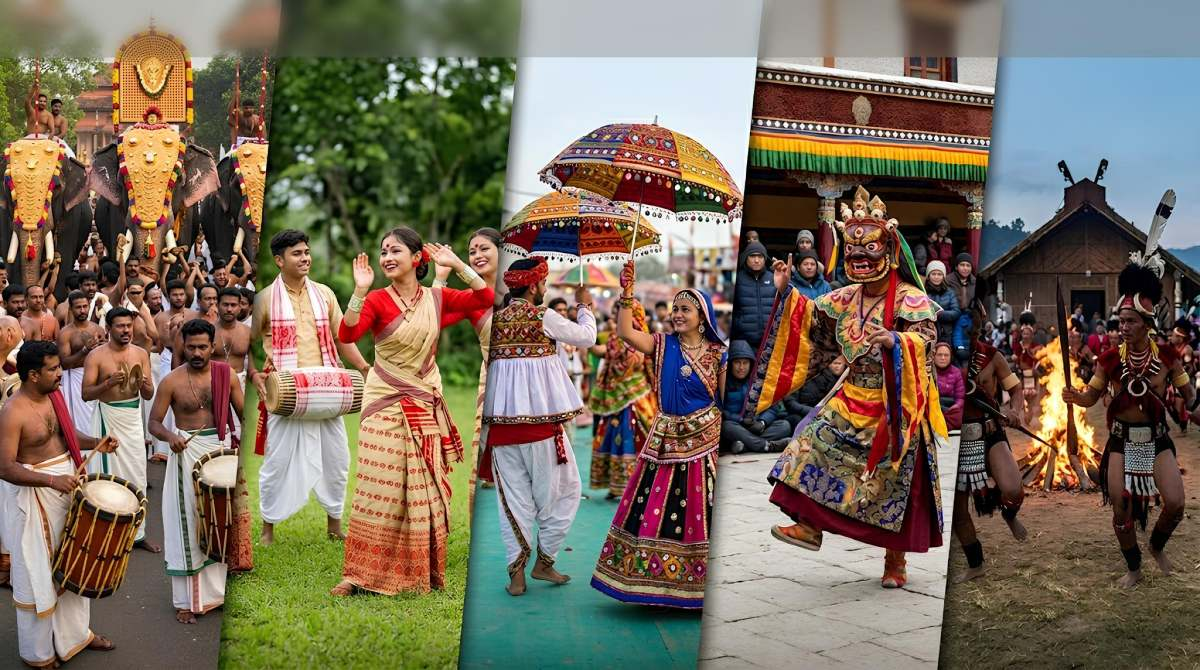
The easiest way to get confused about India is to ask for “the” Indian tradition. There isn’t one. There’s the grandmother in Tamil Nadu who draws a pattern outside her door every morning without thinking about it, the Bengali family that plans its entire year around five days in autumn, and the camel trader in Rajasthan who treats a religious fair as a business trip. Each of them would call their way completely normal, and each would be a little surprised by the others.
That’s what makes the cultural traditions of India so interesting, and so hard to pack into a tidy list. This one doesn’t pretend to be complete. It’s ten traditions from different regions, picked because they feel different from each other and because each one says something about how people here gather, welcome and celebrate. Some are famous, some are quieter, and all of them are better understood by showing up than by reading, though reading is a decent start.
Small Habits That Say a Lot


Namaste and Leaving Your Shoes Outside
Visitors often expect India’s customs to be dramatic. Then they walk through a door and discover that the biggest cultural lesson is a pair of sandals.
Taking off your shoes before entering a temple or someone’s home is standard, partly for cleanliness and partly out of respect. The greeting is just as simple: palms together, a slight nod, “namaste.” Regions have their own versions, like “vanakkam” in Tamil Nadu, “sat sri akal” in Punjab and “nomoshkar” in Bengal, but namaste is understood almost everywhere. If you’re nervous at a doorway, glance at the floor. A row of chappals tells you what to do.
Kolam, the Morning Drawing
In much of Tamil Nadu, mornings start with a small ritual. Someone sweeps the entrance, sprinkles water and draws a pattern with rice flour. Some kolams are a few dots and curves. Others look so intricate you’d assume a machine made them.
Elsewhere, similar floor art is called rangoli and is often made with coloured powder or petals, especially around Diwali. The idea is to welcome guests and good fortune. Rice flour also traditionally fed ants and other tiny creatures, so the custom quietly doubled as a bit of everyday kindness. It’s a good reminder that many Indian traditions started as practical habits and gained meaning over time.
Rituals of Faith
Ganga Aarti in Varanasi
Every evening at the ghats of Varanasi, especially Dashashwamedh Ghat, priests perform the Ganga Aarti. Lamps are swung in rhythm, bells ring, chants rise over the river and the crowd on the steps and the boats goes quiet in a way crowds rarely do.
It’s less a performance than a daily offering, which is why it feels different from most tourist events. Arrive early if you want a decent spot, and keep your belongings secure, since the area gets packed. Watching from a boat gives you a wider view, though the steps give you a better sense of the atmosphere.
Durga Puja in Kolkata
If there’s one festival where art, devotion and neighbourhood pride collide, it’s Durga Puja in Kolkata. Local committees build pandals, temporary structures that can look like palaces, forests or modern art installations, while artisans spend weeks sculpting the goddess.
The festival includes sindoor khela, when married women apply vermilion on each other on the last day, followed by the emotional immersion of the idols in the river. UNESCO has listed Durga Puja in Kolkata as Intangible Cultural Heritage. For visitors, the real experience is pandal-hopping after dark. Wear comfortable shoes, since you’ll walk for hours, and eat at every stall that smells good.
Theyyam in North Kerala
Theyyam is a ritual art form found mainly in Kannur and Kasaragod. Performers wear towering headgear, painted faces and vivid red and orange costumes, and during the ritual they’re believed to embody a deity. The drums, the firelight and the sheer physical intensity make it very hard to look away.
Performances usually happen in village shrines during the cooler months, roughly from late autumn to spring, and many continue through the night. This is a living ritual, not a staged show. Keep a respectful distance, ask before taking photos and follow whatever local organisers tell you.
Harvests and New Years


Onam in Kerala
Onam is Kerala’s harvest festival, celebrated in the Malayalam month of Chingam, usually around August or September. Homes decorate their doorsteps with pookalam, floral carpets that tend to grow bigger and more detailed as the days pass.
The centrepiece is the sadya, a vegetarian feast on a banana leaf with a dozen or more dishes. There’s a traditional order to serving and eating, so if you’re invited, watch what others do and copy them. You may also see vallam kali, the snake boat races, where rowers paddle to loud, cheerful songs. It’s nearly impossible to watch one while sitting still.
Bihu in Assam
Bihu is Assam’s best-known celebration, and it comes in three forms tied to the agricultural year. Rongali Bihu, usually in April, marks the Assamese new year and the arrival of spring. Villages fill with music, drums and the quick, rhythmic Bihu dance, and many people wear traditional clothes, including the gamosa, a white cloth with a red border that doubles as a sign of respect.
What stands out is how communal it feels. Dancing isn’t left to professionals; neighbours and cousins join in, whether or not they know the steps. If you’re lucky enough to attend, don’t hang back at the edge. Someone will probably pull you in.
Fairs and India Festivals That Take Over a Town
Pushkar Camel Fair in Rajasthan
Around Kartik Purnima, usually in October or November, the small town of Pushkar fills with camels, horses, traders and travellers. It began as a livestock market and still works as one, but it also includes folk music, turban-tying contests, camel races and pilgrims bathing in the sacred lake.
It’s a good example of how Indian traditions often mix business, faith and entertainment without anyone seeing a contradiction. Rooms sell out early and prices rise, so book ahead. If you can manage it, wander around at dawn, when the camels are being groomed and the crowds haven’t turned up yet.
Lathmar Holi in Barsana and Nandgaon
Most of India celebrates Holi with colours and sweets. Near Mathura in Uttar Pradesh, the towns of Barsana and Nandgaon add a twist. Women playfully chase men with long wooden sticks called lathis, while the men shield themselves and try not to laugh too hard. Folk songs and colour fill the streets.
The custom is tied to local stories about Krishna and Radha, and it takes place in the days before the main Holi. It gets very crowded, so book your stay early, carry as little as possible and wear clothes you’re willing to lose.
Hornbill Festival in Nagaland
Held in early December at the Naga Heritage Village in Kisama, near Kohima, the Hornbill Festival brings together Nagaland’s many tribes. Each has its own dress, songs, dances and food, which lets you see a wide range of traditions in a few days without chasing villages across the hills.
It’s named after the hornbill, a bird that appears in Naga folklore, and it began in 2000 as a way to celebrate and preserve Naga heritage. Stay in Kohima, check the programme in advance because schedules can change, and try the local food, especially if you enjoy smoky and fermented flavours.
FAQ’s
Q1. What are some unique cultural traditions of India? India has many unique cultural traditions, including greeting others with Namaste, touching elders’ feet for blessings, celebrating traditional festivals, practicing yoga, and performing classical dances.
Q2. Why is India known for its cultural diversity? India is known for its cultural diversity because different regions have their own languages, religions, cuisines, clothing styles, festivals, and customs.
Q3. What are the most famous traditional festivals in India? Some famous Indian festivals include Diwali, Holi, Navratri, Durga Puja, Pongal, Onam, Baisakhi, and Ganesh Chaturthi.
Q4. What are some traditional Indian customs and rituals? Traditional Indian customs include greeting people with Namaste, seeking elders’ blessings, celebrating weddings with regional rituals, and observing religious ceremonies.
Q5. How do Indian traditions differ from state to state? Indian traditions vary by region in language, food, clothing, music, dance, and festivals. For example, Onam is widely celebrated in Kerala, while Bihu is an important festival in Assam.


Leave a Reply