
There is a distinct point along the winding mountain highways of Uttarakhand where the air changes instantly. The heavy, dust-choked heat of the northern plains suddenly breaks, replaced by a sharp, cool draft carrying the scent of crushed pine, wet river stone, and something deeply ancient. This is the sensory threshold of Rishikesh.
To many, it remains an iconic, slow-motion postcard: white-clad ascetics meditating at dawn, the echo of brass bells from riverside temples, and a legacy tied permanently to the spiritual seeking of the late 1960s. But if you only look at Rishikesh through a lens of quiet mysticism, you miss the electrical current running through its veins. It is a town built on a striking paradox—a place where the pursuit of profound inner peace lives right alongside the thrill of voluntary, heart-pounding terror.
The Geography of the Thrill

The geography of Rishikesh practically demands this intense energy. Here, the Ganges is not the sluggish, broad watercourse that crawls through the industrialized plains. This is the river of the high gorges—fast-moving, mineral-rich, cold, and possessing an immense, churning hydraulic power.
The jagged limestone cliffs of the Shivalik range squeeze the river into violent bottlenecks, carving out natural amphitheaters of dense sal forests and massive granite boulders. It is a vertical landscape that challenges anyone who enters. You cannot stay detached when the earth beneath your boots is physically vibrating with the roar of whitewater and the wind howling off the high Himalayan ridges.
Battling the Emerald Currents

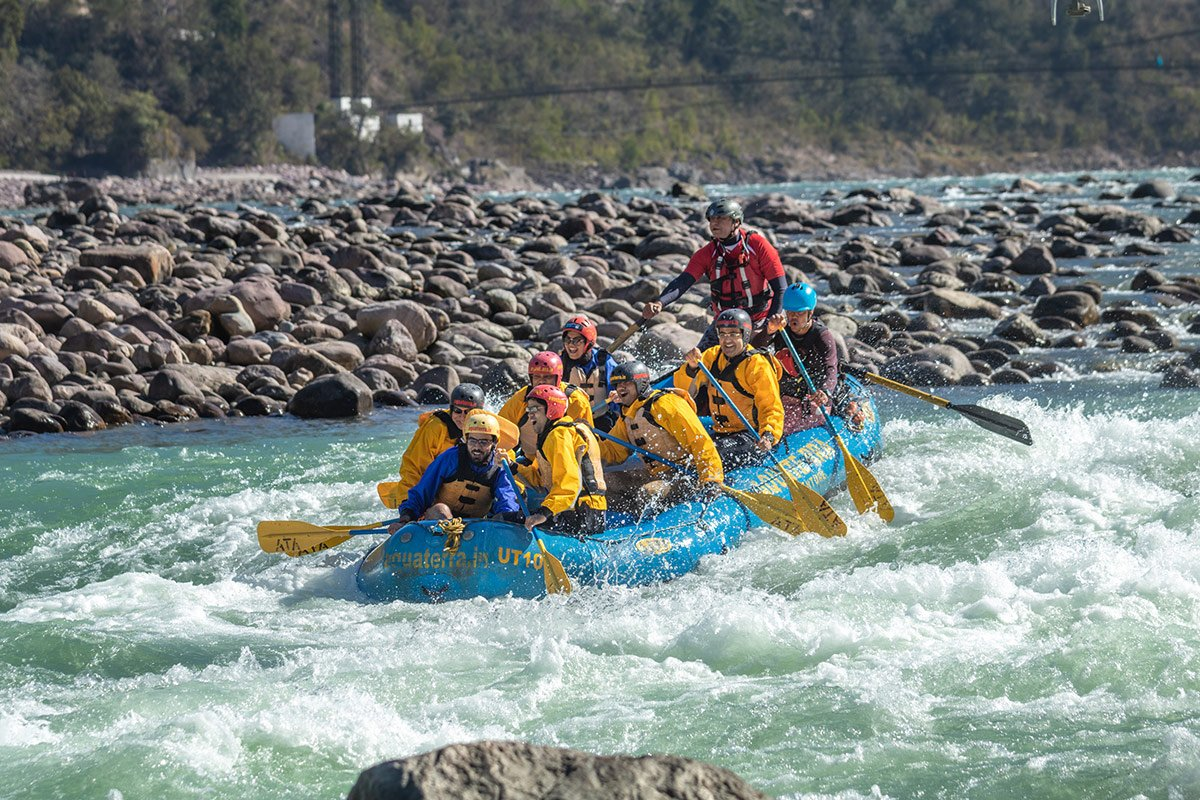
To board a rubber raft on the upper stretches of the Ganges is to willingly enter a high-stakes arena of physics and human muscle. The river sections are named like battlegrounds—Kaudiyala, Marine Drive, Shivpuri, and Brahmpuri—each carrying a specific reputation among professional river guides.
Navigating the rapids of the upper Ganges. Source: Rishikesh Camp
The trip starts with a briefing that strips away any illusion of a theme park ride. You are strapped tightly into a high-buoyancy vest, a helmet is clicked under your jaw, and a heavy paddle is shoved into your hands.
When you push out from the sandy banks, the initial silence is deceptive. The raft glides over glassy, deep-green pools. Then, you hear it: a low, resonant growl echoing from down the gorge. It is the sound of moving water slamming into submerged boulder chains.
As the raft drops into rapids with names like “The Wall” or “Roller Coaster,” the world simplifies instantly. The boat pitches skyward, hangs for a split second on a wall of white water, and plunges into a freezing wave that knocks the air straight out of your lungs.
It requires absolute synchronization. If the team doesn’t dig their paddles into the crest of the wave on the guide’s whistle, the river will flip the boat without hesitation. It is a chaotic, exhausting, and completely intoxicating dance with gravity and fluid dynamics.
The 83-Meter Ledge: Stepping Into Nothing
The platform is an iron cantilever frame anchored directly into a sheer rock face, suspended 83 meters over a rocky canyon bed. It is designed to create a completely unobstructed drop zone—a massive void between you and the valley floor.If whitewater rafting is a team sport of shared rhythm, stepping onto the bungee jumping platform at Mohan Chatti is an intensely solitary, mental standoff against your own evolutionary survival instincts.

The 83-meter free fall platform at Mohan Chatti. Source: River Rafting in Rishikesh
The psychology of the jump lies in the preparation. The slow walk to the edge of the metal grating feels entirely unnatural. As the jump crew loops thick latex cords around your ankles and buckles your backup harness, your pulse spikes.
When you slide your toes over the absolute edge of the platform, your brain stops processing details. The trees below look like small patches of moss; the riverbed looks impossibly narrow.
The jump master begins the rhythm: “Three, Two, One… Bungee!”
Stepping off requires completely overriding your survival instinct. The first few seconds are pure, unweighted acceleration through space as you hit terminal velocity. The wind roar is immediate and deafening.
Just as your mind processes the approaching rocks, the elastic cords smoothly stretch, absorbing the kinetic energy and launching you back toward the sky in a massive, swinging arc. By the time you are lowered down to the recovery team on the river stones below, the terror has evaporated, replaced by an overwhelming, clear euphoria.
The Sunset Equilibrium: Fire on the Water

The true brilliance of Rishikesh is that it doesn’t leave you stranded in a state of high-adrenaline exhaustion. The town possesses an innate ability to ground its travelers, shifting seamlessly from high cortisol to deep peace as the sun sinks behind the western ridges.
| Activity Phase | Physical State | Psychological Transition |
|---|---|---|
| Midday Adventure | High adrenaline, muscle fatigue, sensory overload. | Pushes the body to its physical limits; forces total presence. |
| Evening Transition | Low heart rate, alpha brain waves, deep stillness. | Re-anchors the mind through ancient collective ritual. |
As dusk settles, the focus of the town shifts completely to the stone steps of the ghats. The Ganga Aarti is not a performative show staged for tourists; it is a living, breathing rhythmic ceremony.
The evening Ganga Aarti ceremony. Source: Avian Experiences
Pandits dressed in saffron robes stand on elevated platforms, lifting massive, tiered brass lamps filled with burning camphor. The air grows thick with the smell of incense, sandalwood, and the deep, booming chorus of Vedic chants accompanied by large drums.
As thousands of small leaf-boats bearing clay lamps are set adrift, lighting up the dark, swirling eddies of the river, the frantic excitement of the afternoon completely dissolves. You realize that the intense motion of the rapids and the profound stillness of the aarti are not contradictions at all—they are just two different ways to feel undeniably alive in the same valley.
FAQ’S
1. What is the best adventure activity in Rishikesh?
White-water rafting on the Ganges is the most popular and exciting adventure activity.
2. Is Rishikesh safe for adventure sports?
Yes, adventure activities are generally safe when booked with certified operators who follow proper safety standards.
3. What is the best time to visit Rishikesh for adventure tourism?
The best time is from September to June, when the weather is pleasant and most adventure activities are available.
4. How many days should I spend in Rishikesh?
A 3–4 day trip is ideal to enjoy adventure sports, sightseeing, and the local culture.
5. Can beginners try adventure activities in Rishikesh?
Yes, many activities like rafting, camping, and easy trekking are suitable for beginners with professional guidance.


Leave a Reply